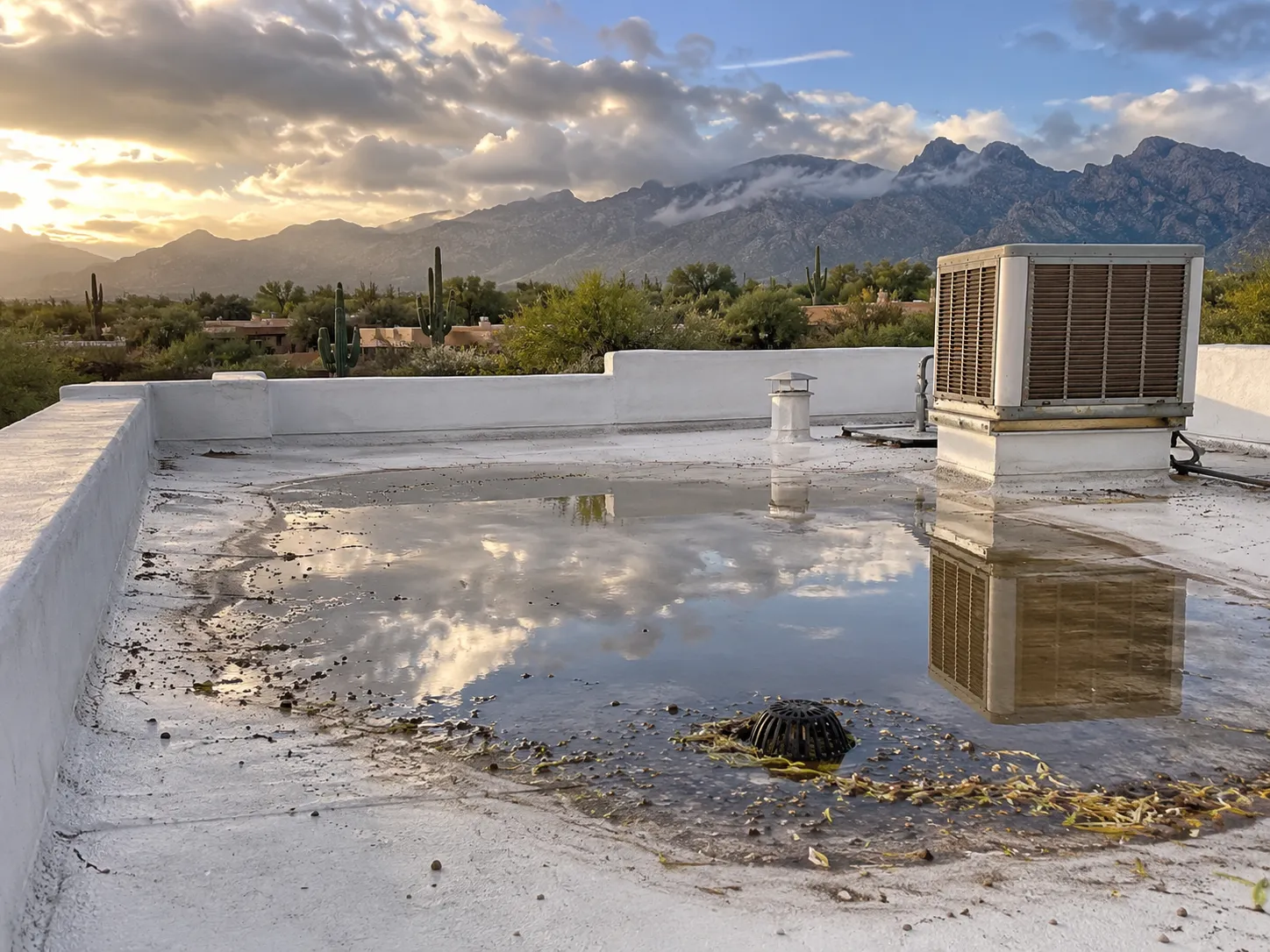
If water is still sitting on your flat roof two days after a monsoon storm, something is blocking drainage or the roof surface has lost its slope. Flat roofs are built with a slight pitch toward drains or scuppers, and water should clear well within 48 hours. Standing water past that point means a drain, a low spot, or the roof structure itself needs attention.
Here's the thing most people don't know. A flat roof isn't flat.
It's built with a gentle slope, commonly a quarter inch of drop per foot, pushing water toward drains or scuppers along the edge. When that system works, a heavy monsoon downpour clears off in a few hours. When it doesn't, you get a puddle that sits there baking in 100-degree sun. And that puddle is doing damage the whole time.
So why does it stay? Usually it comes down to one of a handful of reasons.
- Clogged drains or scuppers. Monsoon winds carry palo verde debris, gravel, and desert dust straight into drain openings. One storm can pack a drain solid.
- Low spots from deck sag. Over the years, decking between joists can settle. The roof develops shallow dishes that hold water no matter how clean the drains are.
- Insulation that got wet and compressed. Once water finds its way under the membrane, the insulation board below can flatten out and create a permanent dip.
- Poor slope from the original build. Some older flat roofs were never sloped correctly, or a later re-roof buried the original pitch under layers of material.
- Blocked overflow scuppers. On some buildings, secondary drains get sealed over or coated shut during past roof work.
A common scenario: a homeowner is sure the roof is leaking, but the real problem is a drain packed with gravel and leaf litter, plus an overflow scupper that was coated shut during an earlier job. Clear the drains and the water is gone. No leak and no replacement, just maintenance that was skipped for a while. It's worth ruling out the simple causes before assuming the worst.
Now, the standing water itself becomes a second problem. The sun hits that puddle all day, and the combination of UV and constant moisture breaks down coatings and seams faster than either one alone.
The National Roofing Contractors Association's standard for proper drainage is that no water remains on the roof 48 hours after a rain, under conditions that allow drying. That's a useful benchmark for any homeowner.
Standing water also adds weight. Water weighs about 5 pounds per square foot for every inch of depth, so a pond just one inch deep across a 20-by-20 section is roughly a ton of load sitting on your deck. That load can make a sag worse, which makes the pond deeper next storm. It feeds itself.
There's one more cause that's common in the desert Southwest: evaporative cooler lines and their roof penetrations. Old cooler curbs and abandoned pipe openings can create raised dams and failed seals right in the middle of the drainage path. They're a frequent source of both ponding and the leak that follows.
Figuring out which cause you're dealing with usually takes someone looking at the roof while the water is still there. That's the clearest way to see where it pools and where it should be going instead.
What Happens If Ponding Water Is Left Unaddressed
Here's the part most people miss. Ponding water doesn't cause a leak on day one. It causes a leak months later, and by then nobody connects the two.
Water sitting on a flat roof works slowly. It softens. It soaks. It finds the one seam that was already a little tired. And in Tucson, the sun does half the damage before the water ever gets involved.
The damage tends to move in a predictable order. Knowing the order helps you figure out where your roof is right now.
- The coating breaks down. Water that sits for days softens many coatings, especially water-based acrylics. The surface chalks, thins, then cracks.
- Seams and flashing soften. Water sits against laps and penetrations for days, and adhesives often give up before the membrane does.
- Moisture enters the roof assembly. It gets past the membrane and into the insulation board or the deck below.
- Insulation stays wet and loses R-value. Wet insulation doesn't dry out easily in a sealed roof system, and it insulates poorly while it's wet.
- The deck weakens. Plywood can delaminate, lightweight concrete stays saturated, and metal decking can start corroding from the top down.
- Deflection gets worse. A sagging deck holds more water, which makes it sag more. That's the loop that turns a small repair into a replacement.
- The leak finally shows up inside. Often nowhere near where the actual problem is.
Step seven is when most people call someone. Steps one through six are when it was cheaper to fix.
There's the weight issue too. At about 5 pounds per square foot for every inch of depth, a pond a couple of inches deep adds real load to a deck that's already sagging. That's a big part of why the 48-hour drainage benchmark exists.
Then there's the stuff nobody thinks about. Algae and plant growth can take hold in standing water. Mosquitoes breed in it, and during monsoon season that becomes a neighborhood problem fast. Dirt and debris settle out of the water and form a crust that holds even more moisture against the surface.
A single wet ceiling tile can be the only visible sign of a much bigger problem. By the time a stain shows up, the insulation around a long-standing pond may be saturated across a large area, and the deck under it may have started to go soft.
Does that mean every puddle is a crisis? No. But it does mean waiting rarely makes the repair smaller.
What a Professional Roof Check Looks for That You Can't See From the Ground
From your driveway, a flat roof looks like a flat roof. You see a parapet wall and maybe a little shine. That's it. The things that cause water to sit for two days are almost always invisible from the ground, and some of them are hard to spot even from the roof surface unless you know what you're looking at.
Here's what a good flat roof inspection checks.
- The water line. Dried mineral residue and dirt rings show how deep the pond got and how wide it spread. That helps tell a half-inch nuisance from a structural issue.
- The drains and scuppers, by hand. Not just by looking. Leaf litter, gravel, and bird nests are common culprits.
- The low spot, for soft decking. If the roof feels spongy underfoot, water has likely gotten into the deck, and it may be sagging further with every storm.
- Every penetration. Evaporative cooler curbs, vent stacks, and old satellite mounts often sit right where water collects, and the sealant around them cooks in the sun.
- Loose coating at seams and edges. Blistered or chalky coating says the membrane underneath has been taking UV for years.
- The parapet walls and their caps. Water pooling against a wall can wick sideways, and the leak shows up in a room nowhere near the pond.
- The attic or interior ceiling, when there's access. Stains, rust on fasteners, damp insulation. The inside tells a story the top can't.
That soft-deck check matters more than people expect. A deck that's gone soft doesn't bounce back when it dries out. It stays low, so the next storm fills the same dish deeper, and the cycle speeds up. Coating over a soft deck is a common mistake, and the pond usually comes back worse.
Water also rarely falls straight down. It finds the path of least resistance and follows it, sometimes for several feet, before it shows up where you can see it. A hallway stain can trace back to water collecting at a parapet twenty feet away, running behind the cap and along a rafter before it drops.
Once the drainage problem is fixed, the surface on top still matters. If an inspection shows the deck is sound and a few shallow low spots can't be fully corrected, the coating has to tolerate some standing water. Acrylic coatings soften where water sits for days, which is why many flat-roof owners choose a
silicone roof coating in Tucson for roofs that pond. Either way, drainage comes first, because no coating changes where water goes.
A proper flat roof inspection also tells you what you don't need. Plenty of ponding problems come down to a clogged drain and a bad seam. That's a repair, not a replacement. An honest answer is the whole point of looking.
Frequently Asked Questions
Common questions about standing water on flat roofs after monsoon storms
Is standing water on a flat roof a problem?
It is once it lasts more than about two days. The National Roofing Contractors Association's standard for good drainage is that no water remains on the roof 48 hours after a rain, under conditions that allow drying. Water that lingers past that point wears down coatings, works on seams, and adds weight to the deck. In Tucson's summer sun, that wear happens faster. If your roof still holds water two days after a storm, something is blocking drainage and is worth a closer look.
How long does monsoon season last in Tucson, and why does it matter for my roof?
Monsoon season in Arizona officially runs from June 15 through September 30. That means a flat roof can take several heavy downpours in a short window, sometimes before the drains have cleared from the last storm. Each new storm adds stress to a drainage system that may already be struggling with debris or low spots. Knowing the season helps you plan roof checks before and between storms instead of waiting for a stain to show up inside.
Are there warning signs before a flat roof fails structurally?
Usually, yes. A sagging ceiling, visible dips in the roof line, cracking sounds, or a deck that feels soft underfoot are all warning signs. Standing water adds real weight, and that weight makes existing sag worse over time. If you notice any of these, stay off the roof and have it looked at promptly.
How do I know if I should call a professional instead of checking the roof myself?
If water is still on your flat roof more than 48 hours after a storm, it's time to have someone look at it. Seeing the roof while the water is still there is the most reliable way to tell where it pools and why. Climbing onto a wet flat roof in Tucson heat carries real risk, and soft spots or loose gravel near drains are easy to miss from a ladder. A licensed roofer can trace the problem back to its source.
Why do Tucson flat roofs seem to pond water so often?
A few local factors stack up. Monsoon winds blow palo verde litter, gravel and dust into drains and scuppers, which can clog them in a single storm. Intense year-round UV wears down roof coatings. And many older Tucson homes have evaporative cooler curbs or abandoned cooler lines on the roof that sit right in the drainage path. Together, those make ponding a common pattern here rather than a rare one.
The Short Version
If water is still on your flat roof two days after a monsoon storm, start with the drains and scuppers, then have the low spots and the deck checked before the next storm. Most ponding problems are cheaper to fix early than after a leak shows up inside.